

The NBA Still Doesn't Have an Answer for Zion Williamson
The new CBA has created a fascinating question: what is a player like Zion Williamson actually worth?

Amidst the humiliation ritual that was New Orleans Pelicans basketball season, something quite interesting was happening the background. As teams search for answers on how to address one of basketball’s brightest — and already one of basketball’s greatest — stars, the Pelicans quietly finished last season with the title of annoying Victor Wembanyama the most, limiting him to his lowest offensive rating1 against a team last season.
There’s an even funnier statistic — Wembanyama is 1-3 against Zion Williamson over the course of his career. Is this somewhat cherry picked given that Wembanyama was 0-2 against Williamson his rookie year, didn’t face each other in his sophomore year and Williamson.
And none of this truly matters. The Spurs would finish the season 3-1 against the Pelicans. The Spurs would still make it to the NBA Finals. And the Pelicans would still finish the season with the eighth worst record in the NBA with no lottery pick to dry their tears.
Totally doesn’t matter….right?
The complicated career of Zion Williamson continued last season. Despite doubling his appearances from the year prior, it also felt like a continuation of a pattern that has become impossible to separate from the player himself. Every stretch of dominant or impressive basketball was followed by another reminder that availability remains the defining variable in his career.
He would average career lows in points per game (21.0), field goal attempts a contest (13.0) and rebounds per game (5.6) while averaging a respectable 29.7 minutes a contest. It would be disingenuous to say he wasn’t a meaningful contributor — he very much was. However, it wouldn’t be a stretch to say he was a player worth centering your future around.
What became more evident this time around was his assimilation into a lesser role — maybe best highlighted in his lowest usage rate of his career at 25.7% and maybe to the chagrin of Pelicans fans stilling holding out hope. It could be argued this was a result of introducing multiple new guards to the equation— Jeremiah Fears and, for their respective stretches, Dejounte Murray and Jordan Poole2.
But here’s the motr honest truth: Zion Williamson had a great season, it just wasn’t him scoring 30 points, averaging a consistent double-double. And most important, the Pelicans also weren’t winning games. That’s becoming a problem.
There is still a gravitational pull Zion possesses when he is on the floor. One of the best utilizations of him is in isolation on the wing, simply because the majority of NBA defenders aren’t equipped to defend someone of his athleticism and skill in space. Not many players, upon catching the ball, force two defenders to already creep in the background to offer that immediate assistance.
Zion does that.
In isolation last season, Williamson averaged 1.07 points per possession with a scoring rate of 55.0% — the highest rate in the NBA last season among players with recording 4 or more isolation possessions per game. And it is so easy to forget at times just how skilled he is.
He has always been known for his barreling capabilities in the same way that a Giannis Antetokounmpo becomes borderline unstoppable once he gets a shoulder past his defender. But reducing Williamson to nothing more than a human battering ram undersells the nuance that has quietly developed in his game.
For someone who weighs close to 300 pounds, his footwork and handles borders on absurd. He'll lull defenders to sleep with a mundane crossover before obliterating them with an explosive first step that shouldn't belong to someone built like an NFL edge rusher.
If that initial advantage disappears, he’ll pivot into a spin move, hesitate long enough to freeze the help defender or extend around a contest with either hand. It isn’t simply power that makes Williamson impossible to contain—it’s the sequencing of his moves.
Every drive feels premeditated.
He understands where the second defender is coming from before they commit, routinely manipulating help defenders with his eyes and shoulders before attacking the smallest opening available. The explosion grabs your attention. The patience is what separates him.
Perhaps the greatest misconception surrounding Williamson is that he lacks finesse. In reality, he possesses some of the softest touch around the basket in the league. Whether it’s a wrong-foot finish, an awkward scoop released before the shot blocker can extend or a high-arcing layup that somehow avoids every outstretched arm, Williamson consistently converts shots that should have no business finding the bottom of the net.
And he’s more malleable than given credit for. Despite being a player where 95.3% of his field goals came less than 10 feet from the basket, he wasn’t pigeonholed to a particular spot on the floor. He wasn’t simply catching the ball on the left block and bullying his way to the rim. The Pelicans deployed him everywhere.
Sometimes it was at the nail, where one dribble immediately forced the weak-side defense into rotation. Other possessions began with Williamson initiating from the top of the key, effectively turning the floor into an empty runway. They used him as a screener to create impossible decisions in pick-and-roll —72.9% scoring rate as the screener, 54.2% as the handler in the two-man, stationed him in the dunker spot to punish overhelp and even let him operate from the elbows where his face-up game could dictate the possession before a defender even had time to react.
That’s the irony of Zion Williamson. His shot chart screams predictability. His game is anything but. It looks like someone accidentally spilled blue paint directly underneath the basket and nowhere else.
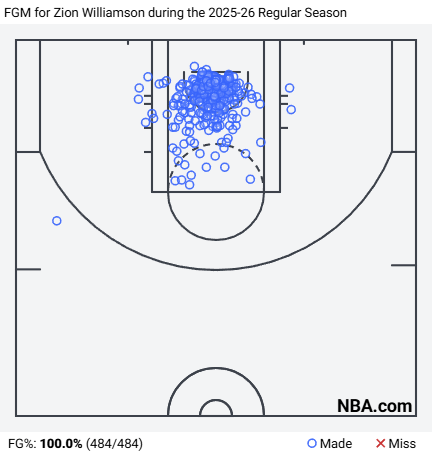
If you showed it to someone without context, they’d probably conclude Williamson is an offensively limited player—a paint-bound finisher who survives exclusively on brute force. Then you watch five possessions and realize those green dots are the product of dozens of different actions, counters and reads.
The destination is repetitive. The journey rarely is.
That’s what has always made evaluating Williamson so fascinating. We often mistake aesthetic variety for offensive versatility. A player who takes step-back threes, fadeaways and floaters appears more skilled than one who relentlessly gets to the rim.
Zion is the opposite.
His offensive package is remarkably diverse despite producing one of the most concentrated shot profiles in basketball. And somewhere along the way, we’ve also started discounting the impact that player still has.
The Pelicans were outscored by 2.6 points per 100 possessions with Williamson on the floor last season, but that statistic says as much about the environment around him as it does the player himself. New Orleans was 3.6 points per 100 possessions worse whenever he sat. In other words, a bad basketball team somehow became noticeably worse without him.
That isn’t the profile of an empty-calorie scorer. It’s the profile of a player who continues to bend defenses even when the surrounding ecosystem fails to capitalize.
The foul drawing illustrates it even better.
Williamson finished 15th in the NBA in personal fouls drawn per game despite the aforementioned averaging under 30 minutes and taking a career-low 13 field-goal attempts. That’s remarkable efficiency. He doesn’t just create shots—he creates consequences. Defenders pick up fouls, rotations collapse, bonus situations arrive earlier and opposing coaches are forced to alter matchups simply to survive his physicality.
Those effects don’t always show up in a box score. They absolutely show up over the course of 48 minutes.
As the basketball world looks for a “Wembanyama stopper,” Williamson weirdly has been one of the closest things we've seen—not because he stops Wembanyama individually, but because he changes the conditions under which Wembanyama is allowed to dominate.
What makes Williamson such a compelling defender is his willingness to attack the core of his opponents. Watching him against Wemby is like a match-up against King Hippo in Punch-Out!!3 because he’s knows the middle is the weakness, especially given Wemby’s handle4 issues.
He knows the influence of getting players off-balance. He knows that if he can get big men to have to divert to their second move or their second option, that is an incredible victory on its own.
And it is why as a defender, he’s consistently winning the 50/50 in isolation — with players only scoring 47.1% of the time against him with a 12.9 turnover frequency and a 44.3% field percentage. Players are shooting 43.5% against him overall — all of this while not being slotted into a rim protector role.
The 2026-27 season is quietly one of the most important of Williamson’s career.
With two years remaining on his rookie extension, he finds himself entering what has become the NBA’s new “Zone of Discomfort”. Next season, his $42.1 million salary will account for roughly 25.6% of New Orleans’ payroll. The following year, $44.8 million climbs to nearly 26%.
Those numbers used to be almost irrelevant. They’re not anymore.
The second apron has fundamentally changed the conversation surrounding star players. Teams aren’t simply asking whether someone is worth a max contract—they’re asking whether they’re worth all of the restrictions that accompany it.
That’s an entirely different question.
Players like Williamson have become the most fascinating case studies in this new landscape. Ten years ago, this conversation would’ve been over before it began. A player with Zion’s talent signs another massive extension because that’s what stars do.
Today, the calculus is far more uncomfortable.
If you’re building a championship roster, can your highest-paid player realistically be someone available for 45 to 65 games every season? If he’s your second-best player, does paying him like your first prevent you from ever acquiring the player you actually need?
Those aren’t criticisms of Williamson. They’re simply the realities of roster construction in 2026 which creates an unusual game of leverage.
Does Williamson prioritize maximizing every dollar available? Does New Orleans hesitate before committing another long-term deal? Is there a compromise somewhere in the middle? Or do both sides quietly acknowledge that the timelines no longer align? Do New Orleans fans even want him to begin with?
Those questions feel significantly more important than whether Zion averaged 21 or 27 points per game.
Because the basketball player isn’t really the mystery anymore. He’s still one of the league’s most unique offensive weapons. He’s still capable of collapsing an entire defense by himself. He still forces Victor Wembanyama—a player who has made life miserable for nearly everyone else—to play basketball on terms he doesn’t necessarily prefer.
That version of Zion Williamson still exists. The mystery is whether an NBA franchise can comfortably build its financial future around him and whether the fanbase is even interested in that future to begin with. New Orleans fans have had it rough when it comes to basketball. They went from a star who spent his final year with the team toying with their emotions in a way that still felt widely misunderstood but nonetheless needlessly cruel.
Zion was supposed to be karma falling back in their favor and instead it has been a litany of jokes surrounding his weight and his infatuation with models on a website that I don’t think I can type into a piece without getting shadow banned and/or botted5.
Basketball fandom is a consistent struggle. We convince ourselves every offseason that this year will finally be different because that’s almost the entire job description of being a fan. Hope isn’t logical. If it were, half the league would’ve checked out decades ago.
Pelicans fans know this better than most.
They’ve watched Chris Paul leave. They watched Anthony Davis leave. They’ve watched injuries derail what should’ve been the defining era of Zion Williamson’s career before it ever truly began. Every time the franchise appears to grab hold of something sustainable, it somehow slips through its fingers.
Which is why Zion remains such a frustrating conversation.
He’s simultaneously overrated and underrated depending on who’s talking. To some, he’s already become an expensive cautionary tale whose availability permanently outweighs everything else. To others, he’s still the generational force who averaged 27 points on absurd efficiency before turning 24 years old and can still warp a defense in ways maybe five players on Earth can.
The truth, as usual, lives somewhere in the middle.
Williamson no longer feels like the player you’re waiting to become something. He already is something. A devastating isolation scorer. An elite interior finisher. An unstoppable force in space with pace. A genuinely impactful defender when engaged. A player capable of making even Victor Wembanyama look uncomfortable for stretches.
That’s a star. The problem is that “star” and “franchise cornerstone” are no longer interchangeable terms in today’s NBA.
That’s the question New Orleans has to answer over the next two seasons.
Not whether Zion Williamson is good enough. He is.
Not whether he can still dominate basketball games. He can.
The question is whether the version of Zion Williamson that exists today—the one who plays 50 games, scores with ruthless efficiency and still bends opposing defenses—is enough to justify building the next era of Pelicans basketball around him under a salary cap designed to punish expensive mistakes.
Maybe the answer is yes. Maybe the answer is no.
But after six seasons, that’s finally the right question to be asked. Now, the hard part is finding that answer.
Offensive and defensive rating really is one of those statistics that should get more love and attention. Offensive rating is just calculating the points a team or player produces per 100 possessions. Wembanyama’s lowest was 96 last season.
Elite hate-watch season from Jordan Poole.
I f***ing love Punch-Out!!
1.32 ratio when it comes to lost ball turnovers compared against bad pass turnovers.
Kind of related but I do have a story about Zion Williamson during his time in Durham that I don’t think I can realistically share now but just know, I have it in the back-pocket.